
Sandra and Lisa, both turned their projects into very interesting and well-conducted Masters theses. Sandra worked on the “Evolutionary comparison of KAP1 binding sites between humans and chimpanzees” and Lisa on the “Functional characterization of ZNF542 and ZEB2 in primates”. The results of both projects gave us new insights in functional differences between TF genes of humans and other primates.
Sandra and Lisa finished their Master theses
Posted in Uncategorized
Comments Off on Sandra and Lisa finished their Master theses
Our paper on the evolution of gene regulatory factors is accepted
Our review paper on “The role of gene regulatory factors in the evolutionary history of humans” is accepted for publication in a special issue on Human Evolution of the journal Current Opinion in Genetics & Development. In our manuscript we review how especially transcription factor and long non-coding RNA genes have changed during human evolution, comparing modern humans to other primates, to archaic humans, and comparing human populations. We provide examples of gene regulatory factors with signs of positive selection and speculate on their impact on shaping human phenotypes.
Congratulations, Alvaro, Bia, and Sabina to a wonderful paper!
Posted in Uncategorized
Comments Off on Our paper on the evolution of gene regulatory factors is accepted
Received funding for our speciation research
The Volkswagen Foundation awarded us funding for our collaborative work on Chromosomal Speciation within their framework “Support for Europe”. In our project “Genomic architecture of speciation: the role of chromosomal rearrangements” Rui Faria’s and our group will use Next Generation Sequencing data from primates and marine gastropodes to investigate the impact of rearrangements in accelerating genome-wide divergence during speciation under different geographic scenarios and across two very distinct taxonomic groups.
Posted in Uncategorized
Comments Off on Received funding for our speciation research
Rohit won the Best Poster prize
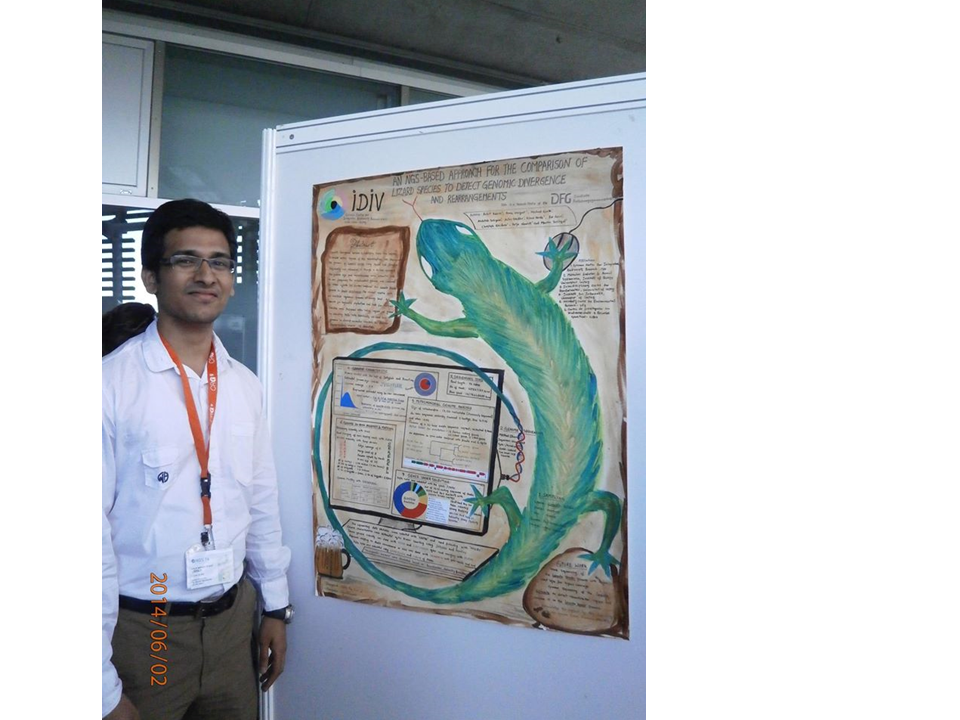
Rohit won the prize for the best poster at the Next Generation Sequencing Conference (NGS) 2014 in Barcelona. His hand-drawn poster shows his work on the lacerta genome. Congrats to an awesome poster!
Posted in Uncategorized
Comments Off on Rohit won the Best Poster prize
Funding for lncRNA evolution project
We got our grant proposal on “Long Non-Coding RNAs in Primate Brain Evolution” awarded. It is funded within the framework of the SPP 1738 “Emerging Roles of Non-coding RNAs in Nervous System Development, Plasticity and Disease”.
Posted in Uncategorized
Comments Off on Funding for lncRNA evolution project
Sabina finished her Masters Thesis
Sabina finished her thesis on the “Role of random monoallelically expressed genes in the
development of Alzheimer’s disease”. Congratulations to an excellent thesis work!
Posted in Uncategorized
Comments Off on Sabina finished her Masters Thesis
Programming for Evolutionary Biology 2014
Our school on Programming for Evolutionary Biology will take place again in Spring 2014! It’s the perfect opportunity to learn programming and the analysis of Next Generation Sequencing data in two and a half weeks. Check out our website. Applications will be accepted now until January 15th.
Posted in Uncategorized
Comments Off on Programming for Evolutionary Biology 2014
Stefano’s talk at the SMBE meeting 2013
Stefano presented his work at the annual meeting of the Society for Molecular Biology and Evolution in Chicago in July 2013. The title of his talk was “Evolution of a Co-expression Network Involved in Primate Brain Functions and Cognitive Abilities”.
Posted in Uncategorized
Comments Off on Stefano’s talk at the SMBE meeting 2013
Interview for MDR-Info
Our Programming for Evolutionary Biology course sparked interest in the German news service. The radio station MDR-Info did an interview with me, which was broadcasted on April 3rd 2013. In the interview I describe the content and philosophy of the course and also talk a bit about how my research group uses bioinformatics to answer questions related to evolutionary biology.
The author of the interview “BiologenWorkshop in Leipzig” is Karsten Moebius, MDR-Info.
Posted in Uncategorized
Comments Off on Interview for MDR-Info
SMBE Symposium: “Evolution of behavior: Comparative genomics and transcriptomics”
Chris Balakrishnan and me are organizing a symposium on “Evolution of behavior: Comparative genomics and transcriptomics” for the SMBE meeting this year.
We invited three excellent speakers: David Clayton, Todd Preuss, and Suzy Renn
The Meeting will take place in Chicago from July 7th to 11th. Online registration will start on January 25th 2013. You are welcome to submit an abstract to the topic of our symposium:
Behavior is a complex phenotype determined by many genes. Behavior is also a plastic phenotype that individuals adjust according to environmental or physiological conditions. A systems biology perspective is therefore appropriate and necessary to study the evolution of behavior. This includes especially the comparative study of multiple genes, their expression and interactions involved in controlling behavior. With genomic and transcriptomic data from relevant study species now readily available and/or attainable, it is timely to bring specialists working on different taxa together to discuss general and taxa specific trends in our understanding of the evolution of behavior. Topics to discuss in this symposium will range from how to bridge the gap from changes in molecular signatures to changes in phenotype, evolution of social behavior, and individual variation in behavior. This symposium will stimulate fresh discussions among ecologists, neuroscientists, molecular and computational biologists to enhance our understanding of the evolution of behavior.
Posted in Uncategorized
Comments Off on SMBE Symposium: “Evolution of behavior: Comparative genomics and transcriptomics”